

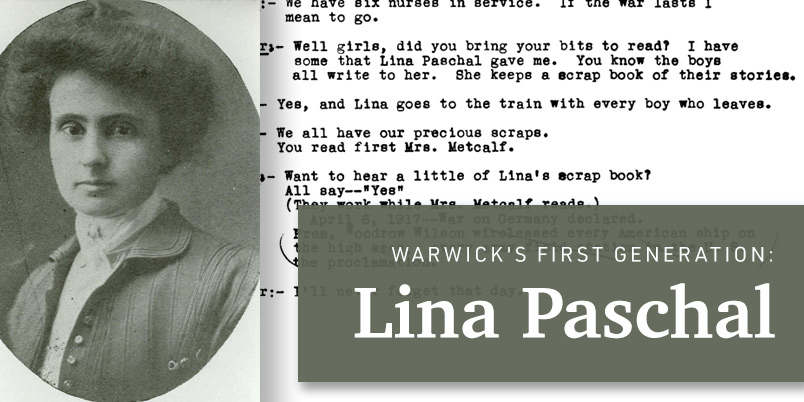
Long before Warwick Publishing became the trusted name for printed merchandise in the promotional products industry, there was a woman in St. Charles, Illinois, who understood something that most people didn’t: paper isn’t passive and that, in the right hands, it’s power.
Her name was Lina Paschal.
Born in 1858 in Columbus City, Iowa, Lina would go on to do something that, at the time, was quietly radical. In 1903, she bought a newspaper, took outright ownership of The St. Charles Chronicle, and stepped into a role few women occupied at the time. Even more, she didn’t just run the paper; she used it.
Through her column, “Table Clatter,” she wrote about the pulse of her community: local happenings, politics, patriotism, and women’s suffrage. She wasn’t always polite, and it wasn’t always universally loved, but that was the point. As she once admitted, not everyone appreciated her opinions, but even those who criticized her continued to read, cementing her influence.
Lina had a sharp wit and very little interest in fitting into anyone’s mold of what she should be. She openly rejected the expectations placed on women of her era, noting she had no desire for domestic life and instead found her energy in the stories, habits, and quirks of real people. That curiosity became her superpower, as she wasn’t simply reporting on the community; she was shaping it.
She became the first woman editor of the paper, the first State Central Committeewoman in Illinois, and, during World Wars I and II, she launched an initiative to send The Chronicle to U.S. servicemen overseas. It became a powerful reminder that connection matters, especially when distance makes it challenging. That idea alone feels strikingly modern because, at its core, it wasn’t about the newspaper so much as about being seen, remembered, and connected.
By the time she sold the paper to her nephew in 1925, Lina had spent more than two decades building not just a publication; she had built a platform. It was one that reflected the voice of a growing community and, as you might suspect, her own. In her farewell reflections, she didn’t boast or grandstand. She simply expressed gratitude for the people, the opportunity, and the chance to contribute to something larger than herself.
And, of course, she kept writing.
After a brief chapter as postmistress, Lina returned to The Chronicle in 1932 as a contributing editor. Truly, stepping away from any conversation wasn’t really her style. She remained connected to the work, the people, and the power of the printed word for more than 40 years. Only an eye impairment finally brought her time at the paper to a close.
She passed away in 1956 at the age of 98, but there’s one thing about people like Lina Paschal: they don’t really leave. They show up in the way a story is told, in the confidence behind a bold opinion, and the belief that something as simple as paper can carry meaning far beyond its size.
As an organization that thrives on turning blank pages into branded experiences, that legacy is remarkably relevant to us at Warwick, because every notepad, calendar, card, jotter, or package starts the same way Lina’s paper once did:
Blank, waiting for someone with a point of view.
Warwick continues the legacy Lina Paschal began: transforming blank paper into something meaningful, useful, and worth holding onto. The tools may have evolved, but the belief behind them hasn’t.
Leave a Comment